What a one-line automaton taught us about title design
 Joris, technical director · · 6 min read
For a documentary about early computing we let a single row of pixels write the opening titles. Here is how Rule 110 ended up on a cinema screen.
The brief was short: an opening sequence for a documentary about the people who built the first programmable machines. The director did not want vacuum tubes, punch cards or anything sepia. She wanted the feeling of a machine thinking for the first time.
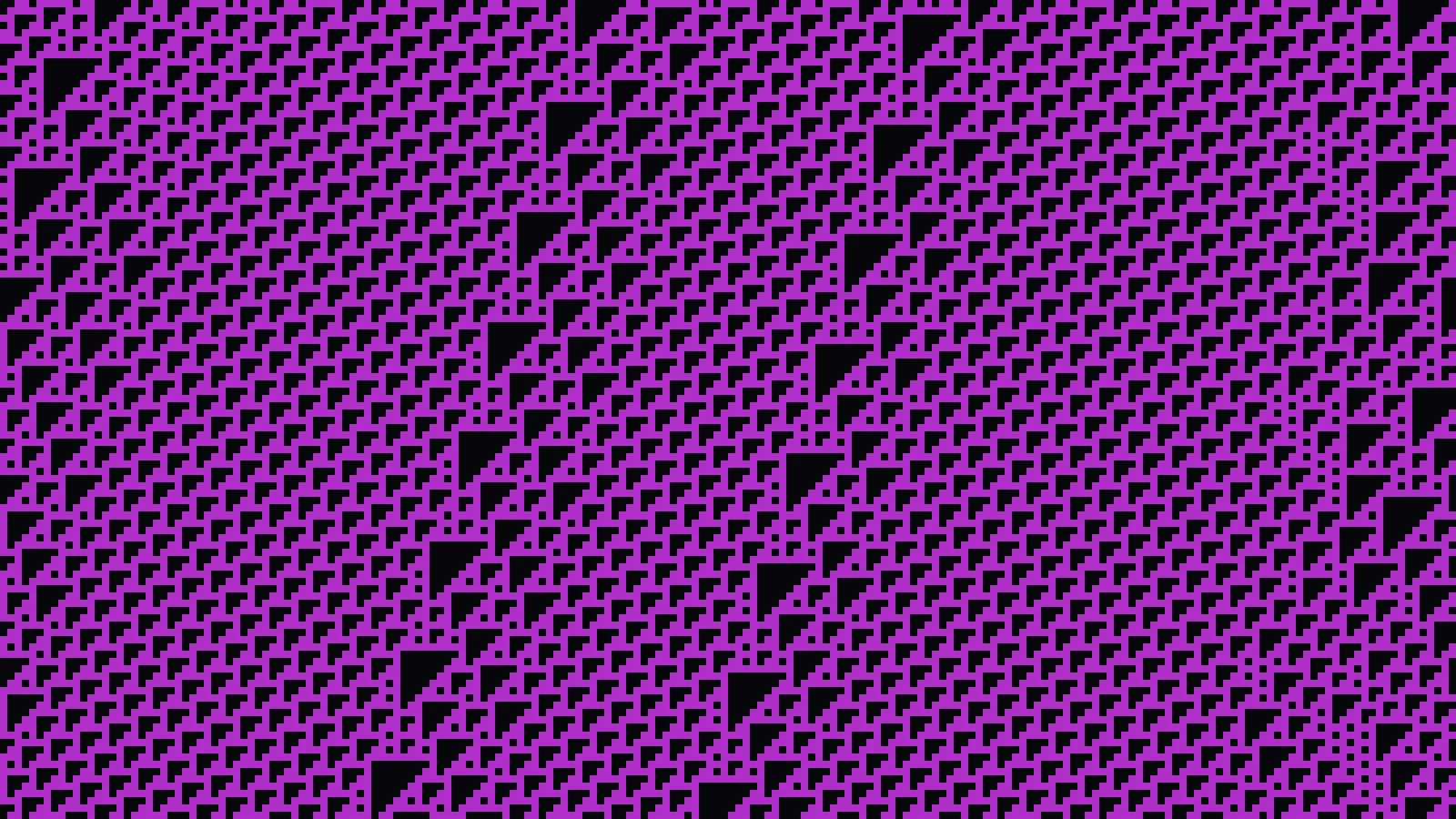
We kept returning to elementary cellular automata. A row of cells, each on or off, and one rule that decides what the next row looks like based on three neighbours. That is all. Most of the 256 possible rules produce either nothing interesting or pure noise. A few produce structure. Rule 110 produces something that looks suspiciously like intent.
Growing a frame, one row at a time
In the finished sequence, every frame is a new row appended at the bottom while the image scrolls upwards. Triangles of every size appear, collide and vanish. Some of them travel across the screen like gliders. It is the visual equivalent of hearing an orchestra tune up: chaos that is clearly heading somewhere.
The rule never changes. Only the starting row does, and that is where all the design work went.
The rule is fixed, so all of our design decisions moved into the initial conditions. We spent two weeks writing small tools that seeded the first row from the names of the people in the film, encoded as bits. Each name produces its own landscape. The director picked the ones she liked, and those became the title cards.
Type that respects the grid
The typography had to live inside the same grid. We set every title in a wide grotesque, snapped it to the cell size and let the automaton flow around the letters, as if the text were an obstacle in a stream. Rendering at four times the final resolution and scaling down with a nearest-neighbour filter kept every cell razor sharp, even on a cinema projector.
The lesson we took away is that constraints are generous. One rule, one row and one colour ramp gave us more variation than we could ever animate by hand, and every frame still feels like it belongs to the same film.